

Catalyzing Critical Thinking
Background: There are usually one to three students in each classroom who have natural predilections for critical thinking, but the majority will do it only if pushed. A few will have great difficulty. How can we assist the latter two categories of students?
What is critical thinking?
- Questioning the truth of a whole article or of specific points within an article
- Questioning the author’s written or unwritten assumptions (or in the case of a film or other digital media – the author’s assumptions as acted or played out within the medium)
- Questioning the relationship between a point and the supporting evidence (such as misuse of statistics or quotations or authorities on a subject)
- Pointing out any logical fallacies or slanted language in a text
- Pointing out two or more opposing ways of thinking about a given proposition
- Showing awareness of weaknesses or inadequacies in one’s own argument
It is wise to require critical thinking on the assignment guidelines.
Five In-Class Critical Thinking Catalysts
A. Dialectical Thinking
B. Provocative Questions
C. Mini-Debates
D. Parliamentary Debate
E. Act Out Your Paper
Dialectical Thinking
This technique works best either at the beginning of class or after the break. Before the class or during the break, get students to assist in moving all the chairs. You can try moving them outdoors or you can put them all up against the wall in an out-of-the-way location. The idea is to leave a large open space in the middle of the classroom where people can move around. (Sometimes I allow sitting in chairs in the corners but sitting tends to be linked to passivity, so it is a second-best choice.)
Put up signs in corners of the room:
I AGREE and I DISAGREE should be on opposite corners.
Plus: two signs at the other two corners which say:
I MOSTLY AGREE BUT HAVE A POINT OF DISAGREEMENT
And
I MOSTLY DISAGREE BUT HAVE A POINT OF AGREEMENT
Another possibility: You can put a sign on one wall halfway between the two which says:
I PARTLY AGREE AND PARTLY DISAGREE.
- Stand in the middle of the room and read out lines from the material the students have been assigned to read for class that day or a film they have just watched. Best lines are thesis statements and supporting points, that is, points that are major issues in the articles. You may want to allow students to hold their books in their hands in order to read the lines along with you.
- Students MUST now walk to a place in the room which matches their point of view.
- Call on students, asking them to tell WHY they have moved to that particular spot, and pushing them to give specific evidence about why they are standing where they are. After a good point, mention that students can use the “evidence” or “information” (PIE) to support their own ideas by saying, “A student in my class explained that she . . . .”
- Keep track of the students and make sure that you call on every single student at some point during the exercise.
- Students are encouraged to move if they figure out that they actually are in the wrong position – that’s good critical thinking!! You can also do some mild cheering for students in one area who have managed to support their position so well that they convince other students to move over.
- I only do two (or at the most three) sentences from any one article – it is more important to get good discussion going.
- However, if you have time, a great exercise is to require people to move to the opposite side of the room (“Dialectical thinking requires moving on a diagonal across the room.”) Students then need to think of reasons to support the opposite of their own initial thinking.
Provocative Questions
This is an excellent exercise to use for critical thinking and review.
In groups of 3, 4, or 5 (you choose), with books open or not (you choose), students
write four questions. You will need to give examples for each type!
- Two questions of fact to which they know the answers (answers from the reading that just shows that people have done the reading).
- A provocative question on which everybody in the group agrees on the answer and can tell WHY based on the reading.
- A second provocative question that is a case where they either don’t know the answer or they truly disagree.
Then, with books closed, the students from different groups have the chance to ask
any question they choose, but must tell whether it is a question of fact, the provocative
question to which they know the answer or the provocative question which they cannot
definitively answer. People around the room raise their hands to answer the questions. On
the opinion questions, people from more than one group can respond – both to the question
and to the answers given by other students. Be sure to ask students to give reasons
(support) for their opinions.
If you do it with points:
- Students get 1 point each time their group ASKS a question.
- Students get 1 point each time their group ANSWERS a question.
- One student keeps track of the points on the board while you facilitate the discussion or you can allow each group to keep track of their own points.
- I often substitute this for a 10-point quiz. To make it fair, everybody gets 5 points as a base and the students love it because they are allowed to get up to 15 or 16 points.
Mini-Debates
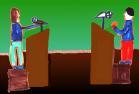 This is great on a day of good weather because pairs and fours can work outside, thus
allowing people actually to hear each other.
This is great on a day of good weather because pairs and fours can work outside, thus
allowing people actually to hear each other.
This exercise should be based on one reading which the students have just completed or on a pair or series of readings all of which are about ONE topic. It is helpful in this exercise to make pairs by numbering off, possibly in fours (the reason will become evident later). Best friends are sometimes less willing to totally disagree with each other.
You can also make your pairs by doing the line-up-across-the-room exercise, with people standing in a position according to one issue. Example:
Agree--------------------------------------------------------------------Disagree
Then after numbering across the room (1-26), 1 goes with 14, 2 goes with 15, etc.]
Before You Begin: Be sure to model what you are hoping will happen in a 3-5 minute mini-mini-debate. For LART teachers, this is a great chance to have two teachers with opposite points on view on something (ie. Objective quizzes vs. essay quizzes). Show them that you begin by taking the opposite of your own point of view and then defend it with one reason, one or two supporting points, a short rebuttal of your partner, and then a concession.
Now, students in each pair MUST take opposite positions on the topic. Remind the students that this may be a chance for some dialectical thinking on their part if they have to take a position with which they don’t fully or even partially concur. Ask them to develop at least TWO reasons IN FAVOR OF that position or TWO reasons AGAINST that position, with each reason supported by some piece of evidence, such as a line from the reading, a personal experience, or an example from film or TV.
Now have them debate against each other for about four or five minutes. First, each person should explain her/ his position and then, after listening to the other side and summarizing it, explain to the other person exactly why that position is incorrect, giving a piece of supportive evidence, if possible.
Outline (though you can do this more informally with good results):
- A gives one reason and support
- B gives one reason and support
- A summarizes B’s point & explains why B is incorrect
- B summarizes A’s point & explains why A is incorrect
- A gives second reason and support
- B gives second reason and support
- A summarizes B’s point & explains why B is incorrect
- B summarizes A’s point & explains why A is incorrect
Direct students to concede some point to the opposition in a friendly fashion.
Now make fours out of the pairs. People on the same “side” will work together. Give the teams time to work together and ask them to consolidate their points into a maximum of three major points.
Now repeat the debate format, only with delineated roles: One person in the pair opens and her / his partner rebuts. Then the partner explains a point and the first speaker on the team rebuts. If there is a third point, they continue. Both make a concession.
If you have time, take a break and then continue on with eights. Have a class discussion afterwards in which you discuss the very best points made. Explain why a concession gives credibility because it shows fairness and openness.
Parliamentary Debate
 This is quite similar to mini-debates except that it involves the whole class and
includes a lot more noise (and you thought the mini-debates were noisy!). Show a clip
of an actual parliamentary debate from a film such as The Pallisers or from BBC News, in which sides stomp against the opposite side and cheer for their own side.
This is quite similar to mini-debates except that it involves the whole class and
includes a lot more noise (and you thought the mini-debates were noisy!). Show a clip
of an actual parliamentary debate from a film such as The Pallisers or from BBC News, in which sides stomp against the opposite side and cheer for their own side.
Students may be separated by actual views or you may number off (you decide, and your decision may be based on cliques in the class). Then give them 20 or more minutes to organize their points and to choose spokespeople and givers of evidence/ support.
Arrange the chairs so that the opposite teams face each other in rows, with the six
speakers on the “bench” in the front row and a person in a fancy wig in the middle
keeping order. You may need a timekeeper as well.
The two teams are called the Proposition and the Opposition.
Here is a version of the format:
- First proposition constructive speech 2 minutes (side cheers for itself)
- Support given by another speaker (2 minutes)
- First opposition constructive speech 2 minutes (side cheers for itself)
- Support given by another speaker (2 minutes)
- Second proposition constructive speech 2 minutes (cheers)
- Support given by another speaker (2 minutes)
- Second opposition constructive speech 2 minutes (cheers)
- Support given by another speaker (2 minutes)
- Opposition rebuttal by 2 completely different people (4 minutes)
- Proposition rebuttal by 2 completely different people (4 minutes)
You MIGHT follow this by a “division of the house,” in which people actually walk through a door to the right (more conservative side of the proposition) or left (more liberal side of the proposition). In this part, they can vote in whatever way they choose. Did you know that this is actually the way the House of Commons votes still?
Act Out Your Paper
 This is a good assignment for EWRT 211 students. It can be adapted to whatever analytical
assignment you choose. Individuals “enact” specific paragraphs as if they were a paper. (Alternatively,
you can have certain individuals enact P’s, some enact I’s, and some enact E’s.)
This is a good assignment for EWRT 211 students. It can be adapted to whatever analytical
assignment you choose. Individuals “enact” specific paragraphs as if they were a paper. (Alternatively,
you can have certain individuals enact P’s, some enact I’s, and some enact E’s.)
Each group should come prepared with visual aids, such as written out (or overhead) thesis and supporting points, flms, or even skits as "information," and possibly costumes.
*If you are already teaching parenthetical documentation, it is fun to have one person
pop up with the parenthesis and citation and then give the Works Cited or References
list at the end.
The whole group does the “hook” or catchy introduction.
A gives the thesis, preferably in a complex sentence with a semi-colon.
B gives the first supporting point and information and evidence.
C gives the next supporting point and information and evidence.
D gives the “however” part of the thesis, again with information and evidence [thus,
critical thinking is built into the structure of the exercise].
E (if you have an E) gives another “however” part, with information and evidence.
The whole group does the conclusion, which connects back to the introduction.