

Group Development
Develop Community During the First Three Weeks of the Quarter
 Fairly simple group
project which students present to class, telling their names as part of the
presentation:
Fairly simple group
project which students present to class, telling their names as part of the
presentation:
- Answering a large philosophical question which is part of the curriculum, such as “What is critical thinking?” or “What is terrorism?”
- A creative group project: Students can create, for example, a myth (Mythology and Folklore) or a story (Fiction)
- Quick analysis: Analyze & explicate a sonnet (Shakespeare) or divide into groups of people who love certain films and analyze those films according to easy categories (acting, cinematography, script, effects, editing)
- Group introductions as opposed to paired introductions (see Pairs)
- Groups develop ground rules for group work or group learning contract
- Scavenger Hunt with people divided into small groups
- Assessment of Ways of Learning and then division into groups of people who learn in similar ways to do a short project. Please ask Marcos Cicerone (864-8366) either to perform the assessment or to train you to do it.
How do I set up informal, short-term groups? During the quarter, using a variety of different ways of forming informal groups will help you as an instructor to avoid biases, to develop the class into a large community, and to help students to develop different skills and new friendships.
- Count off
- Numbered slips of paper
- Playing cards (all aces form a group, all tens, etc.)
- Text match-ups (people with the same line of a poem go together)
- Alphabetical (first four in the alphabet either by first or last name go into the same group, next four go into the next group, and so on)
Sometimes it's wise to let students select themselves into groups, usually by the fact that the people in the group are working on the same topic or assignment.
Collaborative Learning in Informal Groups Throughout the quarter
- Debate in twos, fours, eights on topics related to the reading. Set up really controversial topics! See Mini-Debates.
- Documentation groups: teach aspects of documentation to each other and compete together in a documentation game.
- Quiz or in-class assignment groups. Make the questions difficult and either analytical or critical thinking so that a great deal of give-and-take is involved. Examples of Quiz Questions for Small Groups
- Divide and
conquer: For a particularly difficult
reading, divide into groups and then ask each group to analyze one small
section (1-3 pages) mostly using questions which are common to all but possibly
including questions focused on one group’s section of the reading. Then each group
reports out, possibly using a
diagram or poster to enhance the presentation.
- Example: Conquer “Letter from Birmingham Jail” by asking groups to analyze a 2-page section, looking for ethos, pathos, logos, attention to the audience of 8 white clergymen, anaphora, etc. You may have them report back with all their findings at once OR when you ask for examples of, for example, ethos, each group can give its best example.
- Example: For EWRT 200 or 100B students, ask each group (2-3 students) to teach a grammar chapter such as Fragments, Run-Ons, Sexist Language, Pronoun Agreement, etc. complete with rules and examples.
- Example: for a Shakespeare play, take 3 pages and ask students to highlight themes with different colors, as well as examples of Great Chain of Being, elements of tragedy or comedy, etc.
- Provocative Questions.
- Peer Response Workshops. First, see Peer Response - Alternatives If everybody is writing on somewhat the same topic, I count off and make groups of five or six, so that students will avoid the problem of offending their friends with critiques. If students have selected from a pool of topics, I put students working on the same topic into the same group.
How do I set up informal, short-term groups? During the quarter, using a variety of different ways of forming informal groups will help you as an instructor to avoid biases, to develop the class into a large community, and to help students to develop different skills and new friendships.
- Count off
- Numbered slips of paper
- Playing cards (all aces form a group, all tens, etc.)
- Text match-ups (people with the same line of a poem go together)
- Alphabetical (first four in the alphabet either by first or last name go into the same group, next four go into the next group, and so on)
Sometimes it's wise to let students select themselves into groups, usually by the fact that the people in the group are working on the same topic or assignment.
Formal Groups
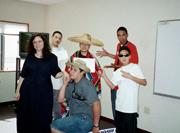 Major projects such as panels
on researched topics, resolution of problems, plays, or panels with contrasting
points of view
Major projects such as panels
on researched topics, resolution of problems, plays, or panels with contrasting
points of view- Support groups for papers, which may be on similar or dissimilar topics
- Default groups so that when you say “Get into your group” for a certain exercise, students always get into the same groups
Issues that arise from setting up Formal Groups for long-term support and learning:
Q: Should I set up heterogeneous (varied skills, varied genders, varied backgrounds) or homogeneous (often a group of self-selected friends, people of the same skill level, same gender, etc.) groups?
Karen Chow: I think in general, I aim for heterogeneity ( e.g. writing skill level, ethnic background, gender, life experiences, etc.) in groups & peer editing & other peer work.Q: What criteria should I use if I try to set up heterogeneous groups?
Q: How can I model excellent group dynamics so that students will make the very best use of the opportunity for small group interaction and learning?
Karen Chow: One way is to assign each group member a specific task (e.g. discussion facilitator, notetaker, presenter, etc). But I notice that if the presenter is not the notetaker, s/he is usually not able to present coherently. I'm not sure what to do about this. I think different tasks need to be defined and tried out.Q: What should I do if a group turns into a social group and is having fun but is consistently off-task?
Karen Chow: I walk around and stop and talk to/get into the groups to get groups back on task if needed. If the group is "dead" ie no one talking, I also jump in and try to facilitate getting them to start asking some questions or do some part of the task they have to do. if they haven't done the reading, then they have to read some small section together and figure out something to do with it.Q: What should I do if one person who has been assigned to a group simply hates working in groups and ends up either completely slacking or else obstructing the work of the group?
Karen Chow: I try to talk to that student individually (usu. ask them to step outside w/ me to talk one on one) and find out what the problem is. I say that participation of some sort is mandatory and everyone has something s/he can share/do and we just have to figure out what that is. Then we work out some way s/he can participate based upon something s/he can do or feels is his/her strength.Q: What should I do if some people totally dominate a group?
Karen Chow: Also, the one-on-one talk. I try to stress how important it is for everyone's learning to have everyone participate in doing the work. Everyone needs to have a chance to earn his/her participation points and it's not fair for one person to dominate and take that chance away from others.